After 20+ Years In Tech, I Discovered Something Most Job Seekers Get Completely Wrong
I’ve sat on both sides of the interview table. I’ve been hired into engineering roles at companies like J.P. Morgan and Legal & General, and I’ve hired and trained developers for my own consultancy, iMobilize.
And here’s what I learned: the highest-paid people in tech are rarely the most skilled people in the room.
They’re the ones who know how hiring actually works.
Most people approach the job hunt completely backwards. They spend months learning yet another framework. They fire off hundreds of identical CVs. They walk into interviews hoping their skills will speak for themselves…
Then they accept whatever salary they’re offered, because they’re just relieved to get a yes.
Applying for a $250k job with a generic CV is like walking into a sales meeting and reading out your product's spec sheet. Nobody buys the spec. They buy the person they trust to solve their problem.
Think about it from the hiring manager’s side. They have a problem that’s costing the business money, a pile of applications that all look the same, and very little time.
They don’t hire the candidate with the longest list of skills. They hire the one who makes them feel certain.
Now Imagine You Approached Your Job Search Like A Sales Process
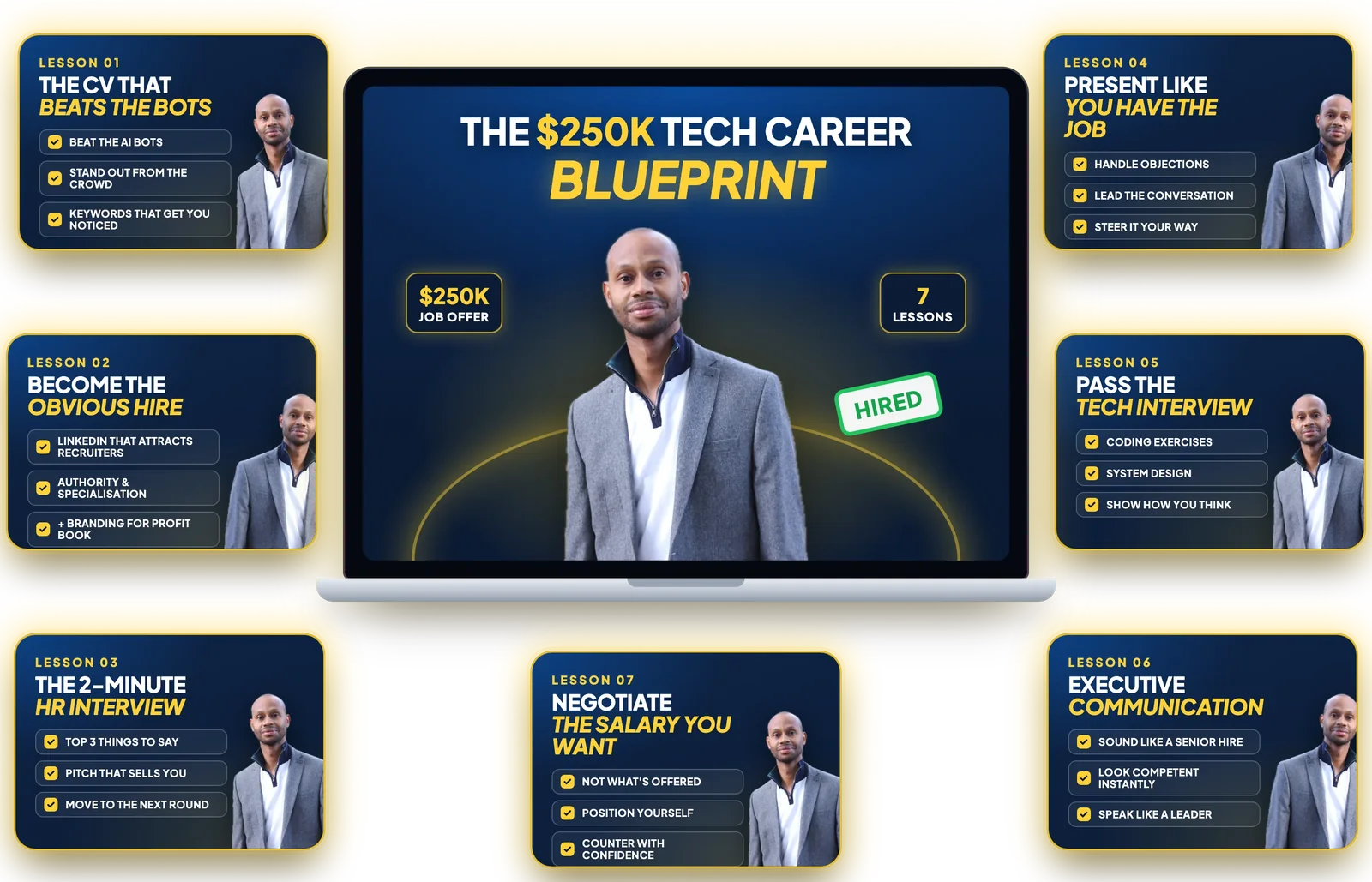
Your CV gets past the AI screening bots and lands on a human’s desk. Your LinkedIn makes you look like the obvious specialist before anyone has spoken to you.
In the first two minutes of the HR call, you’ve already been moved to the next round. In the technical interview you lead the conversation instead of being interrogated.
And when the offer comes, you negotiate from a position of strength, so you get the salary you want, not the one that’s being offered.
Why Getting A $250k Tech Job Is Easier Than You Think
It sounds backwards, but it comes down to supply and demand.
Supply: almost everyone is competing for the same jobs. Graduates, bootcamp grads and career changers all pile into junior and mid-level roles, the jobs with the most applicants and the lowest pay. Very few people position themselves for the senior, architect and principal roles at the top of the market, so the queue for those jobs is far shorter.
Demand: and those top roles are exactly where companies are hiring.
- of the growth in US software development job postings from May 2025 to May 2026 came from senior roles
- 71%
- of the growth in US software development job postings from May 2025 to May 2026 came from senior roles
- Source: Indeed Hiring Lab, July 2026
- rise in US software development job postings since February 2025
- +15%
- rise in US software development job postings since February 2025
- Source: Indeed Hiring Lab, July 2026
- base pay for the top 10% of US software developers, before bonuses and equity
- $214,670+
- base pay for the top 10% of US software developers, before bonuses and equity
- Source: US Bureau of Labor Statistics, May 2025
- software developer, QA and tester openings projected every year for the next decade
- 106,100
- software developer, QA and tester openings projected every year for the next decade
- Source: US Bureau of Labor Statistics, 2025–35
When more of the hiring is happening at the top and fewer people are competing for it, the advantage goes to whoever presents themselves as the senior hire. That’s a skill, and you can learn it.
Sources: Indeed Hiring Lab: AI and job postings · BLS: Software Developers
Why AI Is Killing The Lower Paid Jobs But Increasing The Number Of Higher Paid Ones
AI is now very good at the work companies used to give junior engineers: writing boilerplate, fixing well-defined bugs, writing tests, and turning a clearly written ticket into working code. If a task can be fully described in a ticket, an AI coding assistant can increasingly do it in minutes.
That’s why the bottom of the market is shrinking. Stanford’s Digital Economy Lab, tracking ADP payroll data, has found large employment declines for early-career software developers aged 22 to 25, while the pattern disappears for more experienced workers.
But someone still has to decide what to build, design how the systems fit together, weigh up the trade-offs, review what the AI produces, keep it secure and compliant, and lead the people and processes around it. That’s the work of architects, staff and principal engineers, and AI can’t do it for them.
In fact, every team that uses AI to write more code needs more of that judgement, not less. Indeed found that 37% of the recent growth in software development postings came from jobs with AI in the title.
I see this first-hand leading architecture for an AI agent platform. The AI writes more of the code every month. The people who design the system, set the guardrails and lead the team are more valuable than ever.
The opportunity isn’t to compete with AI at the bottom of the market. It’s to skip that queue entirely and position yourself for the roles AI is creating at the top.
Sources: Stanford Digital Economy Lab: Canaries in the Coal Mine · Indeed Hiring Lab
That's exactly what I teach inside The $250K Tech Career Blueprint.